
The eagerly awaited event dedicated to the art of the Asian continent returns, one of the most acclaimed sales in Cambi’s annual calendar, which once again this year will offer the public a journey through ancient cultures, traditions, and symbolism. The Fine Asian Works of Art auction stands out for its heterogeneity, able to convey the richness and variety of Asia’s artistic heritage through a selection of works from different geographical contexts and distant eras.
The catalogue spans a broad chronological arc, from the Chinese imperial dynasties up to the 20th century, including significant works from Japan and Southeast Asia. This diversity is also reflected in the types of objects presented: refined ceramics and rare porcelains, ritual bronzes of ancient tradition, furnishings and decorative objects, sculptures in precious materials, paintings, and everyday artifacts. This multiplicity of materials, forms, and styles allows us to grasp the dialogue between aesthetics and function that has characterized Asian arts for centuries.
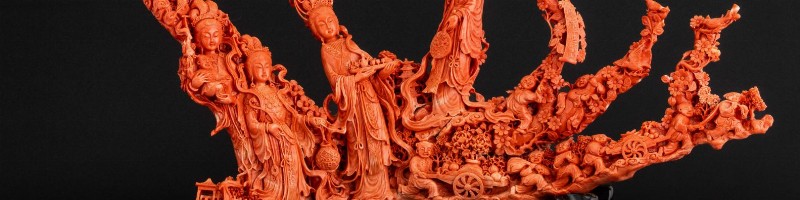
Among the most important lots is a monumental carved red coral, an extraordinary example of Chinese craftsmanship from the 19th century under the Qing Dynasty. The piece, depicting Guanyin surrounded by maidens and vegetation, enriched with inscriptions, stands as a symbol of artistic refinement and is offered in the catalogue with an estimate of €70,000 – €100,000.
Alongside it is a brush pot in jadeite with delicate apple-green and lavender shades, decorated with the figure of Budai and bamboo motifs, made in China during the Republic in the 20th century and estimated at €8,000 – €12,000. It testifies to the continuity of the Asian lapidary tradition and its constant ability to reinvent itself over time.
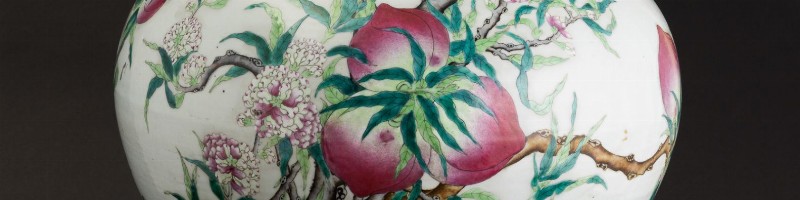
No less significant is a porcelain vase with nine peaches and bats, dating back to the Qing Dynasty during the reign of Guangxu (1875–1908), which combines the technical refinement of the manufacture with the symbolic power of its decorations, linked to concepts of prosperity and good fortune. Estimated at €6,000 – €8,000, it represents one of the most refined objects of imperial ceramic production.
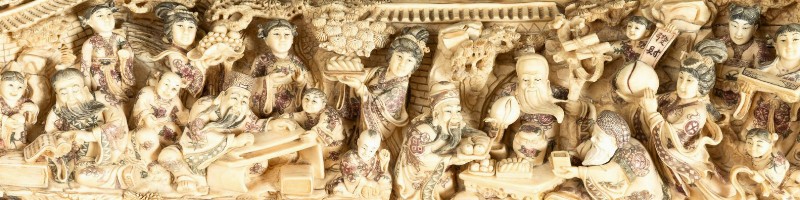
Concluding the selection is an impressive carved mammoth tusk, decorated with a vivid scene of daily life accompanied by inscriptions, a 20th-century work that combines monumental scale with attention to detail, offered in the catalogue with an estimate of €15,000 – €20,000.
The Fine Asian Works of Art auction thus tells the story of the incredible expressive variety of Asian arts. The coexistence of works from different geographical areas, created in diverse eras and through heterogeneous techniques and materials, provides a picture of rare importance.
The Best Awards
![Important and monumental red coral carving depicting Guanyin, maidens, and vegetation with inscriptions, [..]](https://imageapi.cambiaste.com/api/lotto/immagine/340300/0/600.jpg)
Lot N. 15
Important and monumental red coral carving depicting Guanyin, maidens, and vegetation with inscriptions, [..]
Estimate
€ 60.000,00 / 80.000,00
![Important group carved in red coral depicting Guanyin with maidens and squirrels, with raised vegetal [..]](https://imageapi.cambiaste.com/api/lotto/immagine/340294/0/600.jpg)
Lot N. 14
Important group carved in red coral depicting Guanyin with maidens and squirrels, with raised vegetal [..]
Estimate
€ 25.000,00 / 30.000,00
![Large group carved in coral depicting Guanyin with a ruyi and a musical maiden, decorated with raised [..]](https://imageapi.cambiaste.com/api/lotto/immagine/340291/0/600.jpg)
Lot N. 22
Large group carved in coral depicting Guanyin with a ruyi and a musical maiden, decorated with raised [..]
Estimate
€ 10.000,00 / 20.000,00
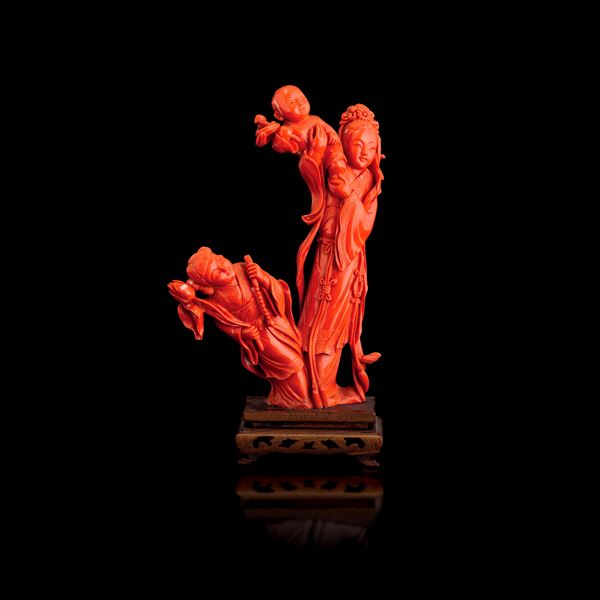
Lot N. 11
Figure of Guanyin with children carved in red coral, China, Qing Dynasty, 19th century
Estimate
€ 8.000,00 / 12.000,00
![Large group carved in coral depicting a battle scene with Guanyin, a dragon, and other deities, China, [..]](https://imageapi.cambiaste.com/api/lotto/immagine/340289/0/600.jpg)
Lot N. 18
Large group carved in coral depicting a battle scene with Guanyin, a dragon, and other deities, China, [..]
Estimate
€ 18.000,00 / 24.000,00
![Large group carved in coral depicting Buddha with Guanyin and children, China, Qing Dynasty, late 19th [..]](https://imageapi.cambiaste.com/api/lotto/immagine/340296/0/600.jpg)
Lot N. 13
Large group carved in coral depicting Buddha with Guanyin and children, China, Qing Dynasty, late 19th [..]
Estimate
€ 15.000,00 / 20.000,00
![Figure carved in coral depicting Guanyin with a maiden and a child, China, Qing Dynasty, 19th century [..]](https://imageapi.cambiaste.com/api/lotto/immagine/338510/0/600.jpg)
Lot N. 6
Figure carved in coral depicting Guanyin with a maiden and a child, China, Qing Dynasty, 19th century [..]
Estimate
€ 4.000,00 / 6.000,00
![Extraordinary and monumental carved mammoth tusk depicting scenes of everyday life with inscriptions, [..]](https://imageapi.cambiaste.com/api/lotto/immagine/340285/0/600.jpg)
Lot N. 188
Extraordinary and monumental carved mammoth tusk depicting scenes of everyday life with inscriptions, [..]
Estimate
€ 15.000,00 / 20.000,00
![Red coral sculpture depicting a fox against a background of relief flowers, China, Qing Dynasty, late [..]](https://imageapi.cambiaste.com/api/lotto/immagine/340298/0/600.jpg)
Lot N. 20
Red coral sculpture depicting a fox against a background of relief flowers, China, Qing Dynasty, late [..]
Estimate
€ 8.000,00 / 12.000,00
![Pair of Famiglia Rosa porcelain vases with naturalistic motifs featuring phoenixes and floral decorations, [..]](https://imageapi.cambiaste.com/api/lotto/immagine/338791/0/600.jpg)
Lot N. 112
Pair of Famiglia Rosa porcelain vases with naturalistic motifs featuring phoenixes and floral decorations, [..]
apocryphal mark of Qianlong (1736–1796)
Estimate
€ 800,00 / 1.200,00
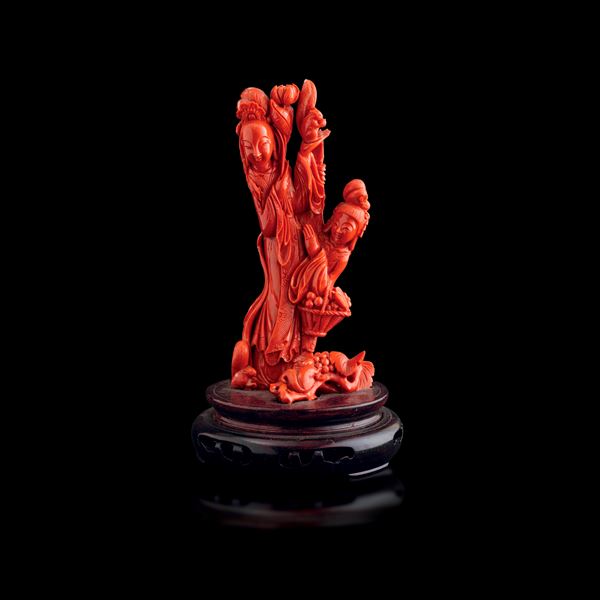
Lot N. 12
Figure carved in coral depicting maidens, China, Qing Dynasty, 19th century
Estimate
€ 3.000,00 / 5.000,00
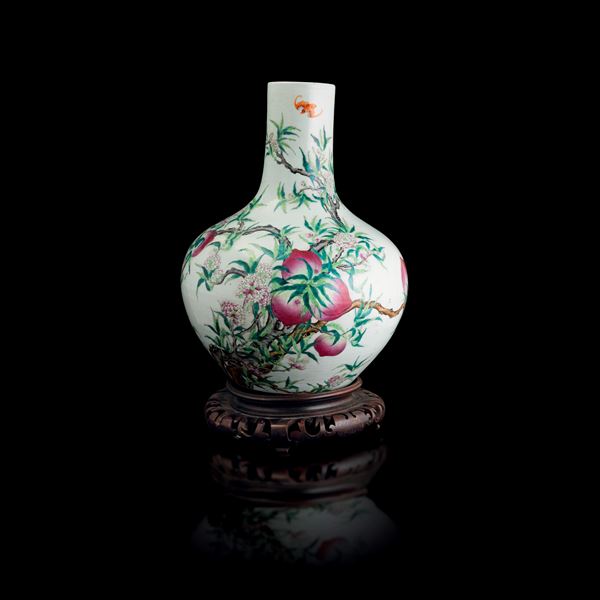
Lot N. 125
Porcelain vase with nine peaches and bats, China, Qing Dynasty, Guangxu period (1875-1908)
apocryphal mark of Qianlong (1736–1796)
Estimate
€ 6.000,00 / 8.000,00
Experts for the auction