214
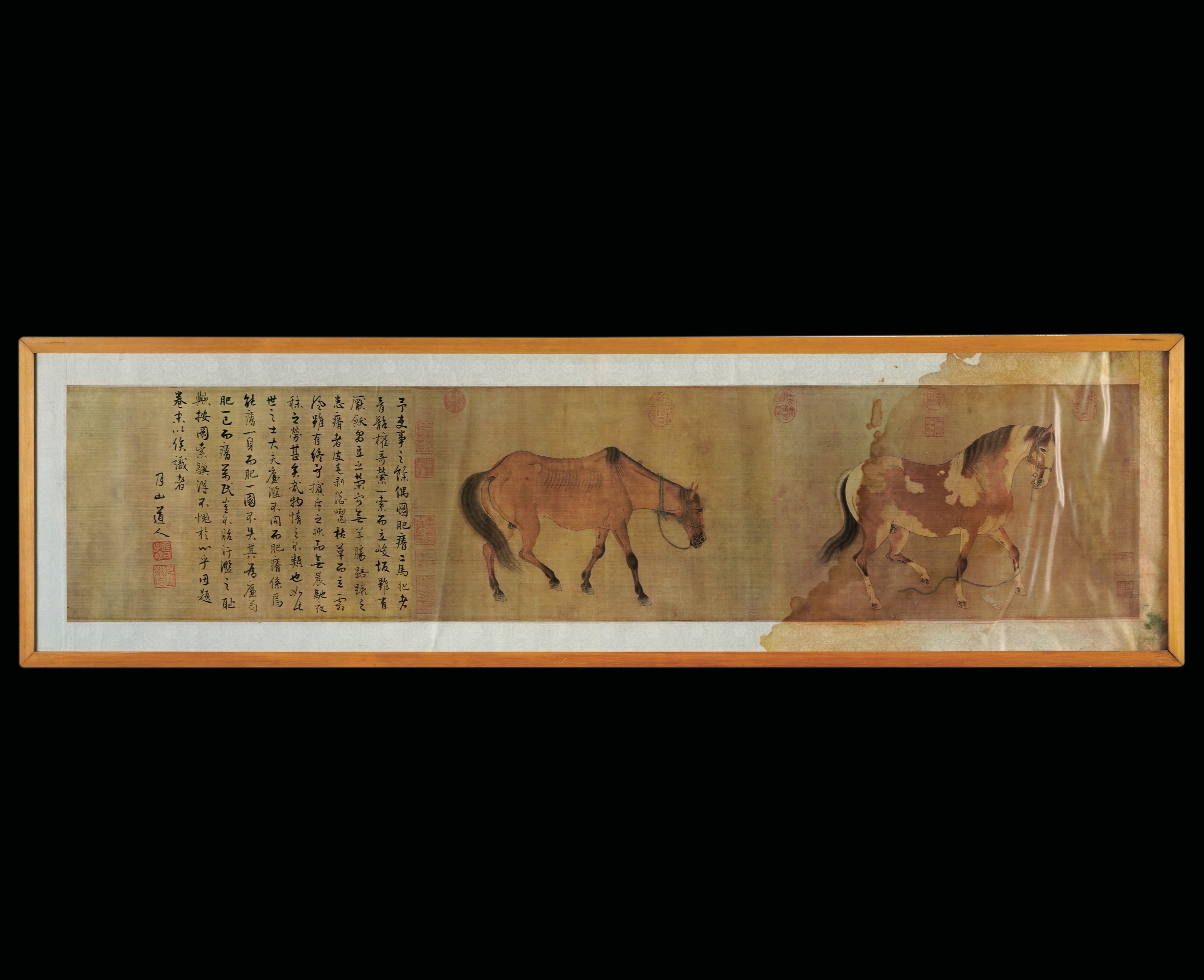
Silk painting printed depicting pair of horses with inscriptions, inspired by Ren Renfa's “Er Ma Juan” of the Yuan Dynasty, China, 19th century
Description
Silk painting printed depicting pair of horses with inscriptions, inspired by Ren Renfa's “Er Ma Juan” of the Yuan Dynasty, [..]
cm 133X29
The painting depicts a strong, well-fed, and robust dappled horse, holding its head high and chest out, stepping lightly and gracefully, with its tail flowing in the wind, exuding a sense of ease and pride. Following behind is a thin, emaciated horse, with its ribs clearly visible, head lowered, walking unsteadily with a tucked-in tail, appearing exhausted and struggling. The artist, employing highly realistic techniques and fine brushwork, skillfully outlines the contours of the horses with expressive lines before applying colors, adhering to the tradition of Tang dynasty horse painting.
In the inscription of Two Horses, the artist uses the two horses as a metaphor to critique the gains and losses, as well as the pros and cons, of the bureaucratic system. He likens the fat horse to corrupt officials who thrive by exploiting the people, thus growing plump and strong. In contrast, the thin horse represents honest and diligent officials who, due to their devotion to governance, are left worn-out and emaciated. The artist then expresses his stance that one should take the former as a warning and the latter as an example.
Observing the horses’ heads, the fat horse wears an elaborate dragon-headed bridle with loose reins dragging on the ground, whereas the thin horse has no bridle, and its reins remain tight around its neck. This symbolizes that an unrestrained horse, lacking control, will become lawless and exploit the people for its own gain. In contrast, a horse with reins, kept in check, will serve with dedication, diligence, and frugality.
Through this straightforward yet profound artistic expression, Ren Renfa conveys his views on the management of officials, demonstrating his deep concerns. The underlying message is clear: if a society lacks supervision and regulatory mechanisms, corruption will inevitably arise.
Although this scroll is a reproduction of Ren Renfa’s work from the Yuan dynasty, it is equally remarkable in its expressiveness and successfully conveys its satirical message. The original piece is housed in the Palace Museum in Beijing.
In the inscription of Two Horses, the artist uses the two horses as a metaphor to critique the gains and losses, as well as the pros and cons, of the bureaucratic system. He likens the fat horse to corrupt officials who thrive by exploiting the people, thus growing plump and strong. In contrast, the thin horse represents honest and diligent officials who, due to their devotion to governance, are left worn-out and emaciated. The artist then expresses his stance that one should take the former as a warning and the latter as an example.
Observing the horses’ heads, the fat horse wears an elaborate dragon-headed bridle with loose reins dragging on the ground, whereas the thin horse has no bridle, and its reins remain tight around its neck. This symbolizes that an unrestrained horse, lacking control, will become lawless and exploit the people for its own gain. In contrast, a horse with reins, kept in check, will serve with dedication, diligence, and frugality.
Through this straightforward yet profound artistic expression, Ren Renfa conveys his views on the management of officials, demonstrating his deep concerns. The underlying message is clear: if a society lacks supervision and regulatory mechanisms, corruption will inevitably arise.
Although this scroll is a reproduction of Ren Renfa’s work from the Yuan dynasty, it is equally remarkable in its expressiveness and successfully conveys its satirical message. The original piece is housed in the Palace Museum in Beijing.
Live auction 982
Fine Asian Works of Art
thu 20 February 2025
Milan
FIRST SESSION
20/02/2025 Hours 09:30 am
Lots 1/227
SECOND SESSION
20/02/2025 Hours 02:30 pm
Lots 250/423