
Among the most outstanding lots is lot 12, a Venetian majolica vase (or ‘boccia’) from the workshop of master Domenego, executed between 1560 and 1570, a masterpiece decorated with trophies of arms and musical instruments. This example of 16th-century Venetian ceramics highlights the mastery of Domenego's workshop, which dominated local production in the second half of the century.
Of great interest is lot 28, a majolica albarello from Laterza dating back to the end of the 17th century, decorated with a refined heraldic coat of arms supported by two angels, an expression of the Apulian pharmaceutical tradition, followed by lot 29, a dish also in majolica from Laterza dating back to the last twenty years of the 17th century, characterised by a turquoise decoration with a bipartite coat of arms and a 17th century female figure, a typical element of A.A. d'Alessandro's repertoire.
Worthy of note is lot 36, a Castelli pump plate attributed to Francesco Grue, circa 1645, depicting the episode of Alexander the Great covering the body of Darius with his chlamys. The work, inspired by an engraving by Antonio Tempesta, is close to a piece in the Louvre Museum, confirming the extraordinary pictorial quality of this Castelli workshop.
A rare allegorical majolica riser by Francesco Grue between 1640 and 1650 (lot 37) shows a gentlewoman intent on mirroring herself, accompanied by allegorical symbols of worldly pleasures, in a luxurious architectural interior.
Among the other specimens in the auction, of particular note is lot 40, a large majolica plate by Carlo Antonio Grue from 1675-1680, decorated with a scene from Torquato Tasso's ‘Gerusalemme Liberata’, in which Rinaldo and Armida are immersed in a large fairytale landscape.
Francesco Antonio Saverio Grue created and signed in 1727 the plaque with the scene from the Aeneid (lot 45) depicting the encounter between Mercury and Aeneas. This work bears witness to the mastery of the painter from Castellano, who was successfully active in Naples in the first half of the 18th century.
A pair of roundels by Liborio Grue, made between 1730 and 1740 (lot 49), depict mythological scenes inspired by Flemish engravings. The pictorial rendering and the ornamentation of the brims lead back to the repertoire of Carlo Antonio Grue, but the particular decorative imprint suggests attribution to his son Liborio.
A plaque with the tenth station of the Via Crucis, painted around 1750 by Berardino or Giacomo Gentili (lot 51) was part of a series of castellated plaques, similar to those decorating the chapel of Palazzo Doria Pamphili in Rome.
Of great interest is lot 59, a pair of ‘ribbed’ plates made by Aurelio Grue between 1750 and 1760 in Castelli or Atri. Moulded in the mould, they feature allegorical female figures inspired by engravings by Johann Sadeler I and Marteen De Vos, two Flemish artists active in Venice in the late 16th century. The brim is decorated with winged putti in grey monochrome and polychrome flower bouquets.
Modelled and painted around 1660 in the Pescio Factory in Albisola is the monumental apothecary stagnone of lot 71. This imposing vase, decorated with oriental landscapes and naturalistic scenes, bears the mark of the prestigious manufactory and is an exceptional example of 17th century Ligurian apothecary vase production.
Lot 118, a two-handled amphora majolica vase from the Ginori factory, datable between 1873 and 1895, is decorated with a scene from Ovid's ‘Metamorphoses’; an example of the production of artistic majolica introduced by Ginori in the second half of the 19th century.
A rare complete set of eleven Toby-Jugs from the English Wilkinson factory, produced between 1915 and 1919, reproduces allied commanders of the First World War and is a limited edition set.
The pair of porcelain jardinières from the Minton Porcelain Manufactory of 1869 (lot 174), is one of the most striking works in the auction, characterised by sculpted caryatids and floral and ornithological motifs, an example of the excellence of Victorian English ceramics.
In this rare and eye-catching ‘Sea Life’ chess set in Meissen porcelain (lot 184), created around 1945 by designer Max Esser, the pawns take the form of sea creatures.
Among the other specimens in the auction, of particular note is lot 40, a large majolica plate by Carlo Antonio Grue from 1675-1680, decorated with a scene from Torquato Tasso's ‘Gerusalemme Liberata’, in which Rinaldo and Armida are immersed in a large fairytale landscape.
Francesco Antonio Saverio Grue created and signed in 1727 the plaque with the scene from the Aeneid (lot 45) depicting the encounter between Mercury and Aeneas. This work bears witness to the mastery of the painter from Castellano, who was successfully active in Naples in the first half of the 18th century.
A pair of roundels by Liborio Grue, made between 1730 and 1740 (lot 49), depict mythological scenes inspired by Flemish engravings. The pictorial rendering and the ornamentation of the brims lead back to the repertoire of Carlo Antonio Grue, but the particular decorative imprint suggests attribution to his son Liborio.
A plaque with the tenth station of the Via Crucis, painted around 1750 by Berardino or Giacomo Gentili (lot 51) was part of a series of castellated plaques, similar to those decorating the chapel of Palazzo Doria Pamphili in Rome.
Of great interest is lot 59, a pair of ‘ribbed’ plates made by Aurelio Grue between 1750 and 1760 in Castelli or Atri. Moulded in the mould, they feature allegorical female figures inspired by engravings by Johann Sadeler I and Marteen De Vos, two Flemish artists active in Venice in the late 16th century. The brim is decorated with winged putti in grey monochrome and polychrome flower bouquets.
Modelled and painted around 1660 in the Pescio Factory in Albisola is the monumental apothecary stagnone of lot 71. This imposing vase, decorated with oriental landscapes and naturalistic scenes, bears the mark of the prestigious manufactory and is an exceptional example of 17th century Ligurian apothecary vase production.
Lot 118, a two-handled amphora majolica vase from the Ginori factory, datable between 1873 and 1895, is decorated with a scene from Ovid's ‘Metamorphoses’; an example of the production of artistic majolica introduced by Ginori in the second half of the 19th century.
A rare complete set of eleven Toby-Jugs from the English Wilkinson factory, produced between 1915 and 1919, reproduces allied commanders of the First World War and is a limited edition set.
The pair of porcelain jardinières from the Minton Porcelain Manufactory of 1869 (lot 174), is one of the most striking works in the auction, characterised by sculpted caryatids and floral and ornithological motifs, an example of the excellence of Victorian English ceramics.
In this rare and eye-catching ‘Sea Life’ chess set in Meissen porcelain (lot 184), created around 1945 by designer Max Esser, the pawns take the form of sea creatures.
The Best Awards
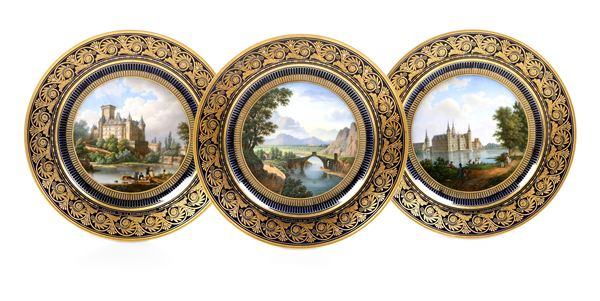
Lot N. 169
Tre piatti dalla fornitura reale “Vues pittoresques de l’Europe” Sèvres, 1827-1829 circa
Porcellana. Marca: “X" coronato con giglio, “Sèvres” “27” rispettivamente “28” in blu. Diametro cm 23,5. Conservazione: ottima Il servizio “Vues pittoresques de [..]
Estimate
€ 4.800,00 / 6.200,00
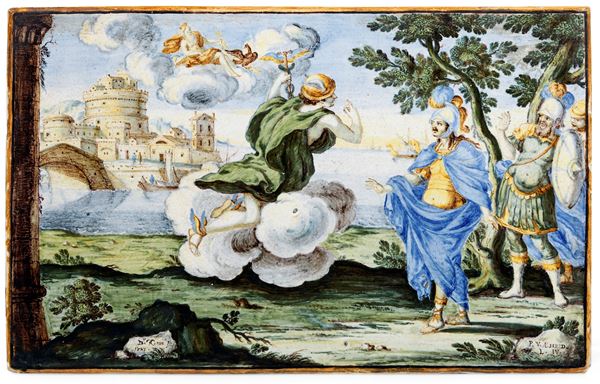
Lot N. 45
Targa con scena dell’Eneide Napoli, Francesco Antonio Saverio Grue, datata 1727
Maiolica. Marca: nella decorazione “Dr.F.Grue p. 1727”. Dimensioni: cm 22,5x36. Conservazione: ottima Interessante targa rettangolare che raffigura [..]
Estimate
€ 5.000,00 / 9.000,00
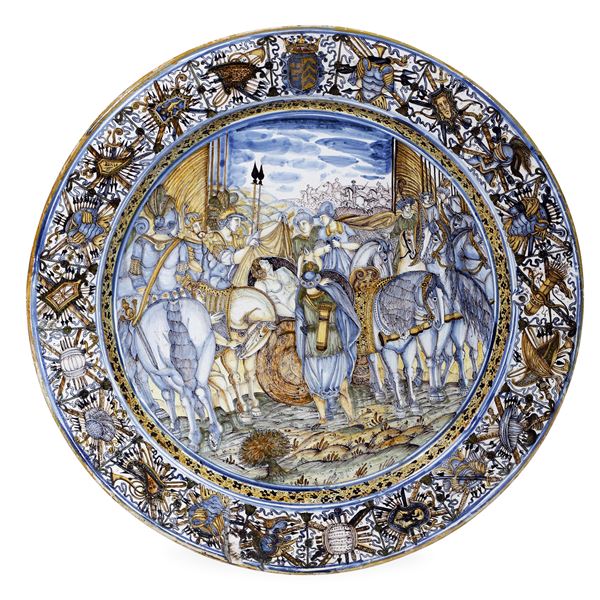
Lot N. 36
Piatto da pompa Castelli, Francesco Grue (1618-1673), 1645 circa
Maiolica. Diametro cm 45. Conservazione: ottima; insignificanti sbeccature al bordo; difetto di cottura sulla tesa alle ore 8.00 Il grande piatto, dalla stretta [..]
Estimate
€ 4.000,00 / 6.000,00
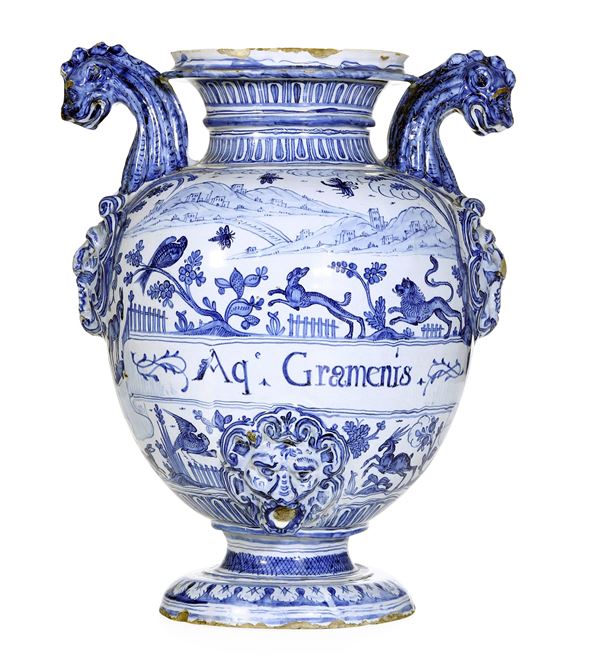
Lot N. 71
Eccezionale stagnone di farmacia Albisola, fabbrica Pescio, sesto decennio circa del XVII secolo
Maiolica. Marca: pesce. Altezza cm 44. Conservazione: ottima; qualche sbeccatura e salti di smalto ai bordi Nel novero delle ceramiche liguri di farmacia lo stagnone [..]
Estimate
€ 3.500,00 / 5.000,00
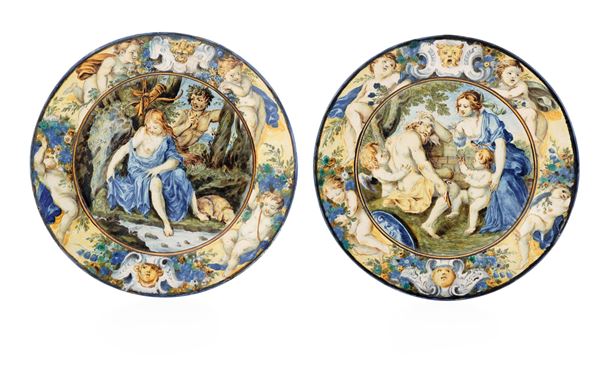
Lot N. 49
Coppia di tondini Castelli, Liborio Grue, 1730-1740
Maiolica. Diametro cm 18,6 circa. Conservazione: ottima; insignificanti cadute di smalto ai bordi. Provenienza asta Christie’s 26/06/2002 lotto nr. 187 Questi [..]
Estimate
€ 3.000,00 / 4.000,00
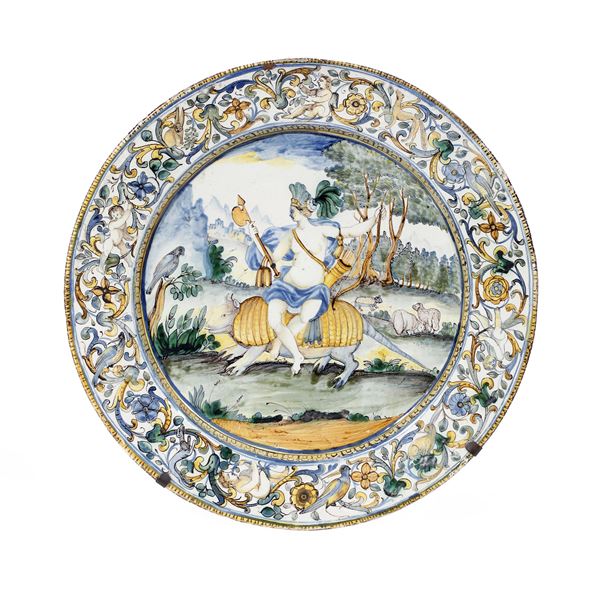
Lot N. 38
Grande piatto “Allegoria dell’America” Castelli, terzo quarto del XVII secolo
Maiolica. Diametro cm 41,2. Conservazione: ottima; insignificanti sbeccature al bordo Questo insolito piatto è istoriato con l’allegoria dell’America. Un pellirossa, [..]
Estimate
€ 1.200,00 / 1.600,00
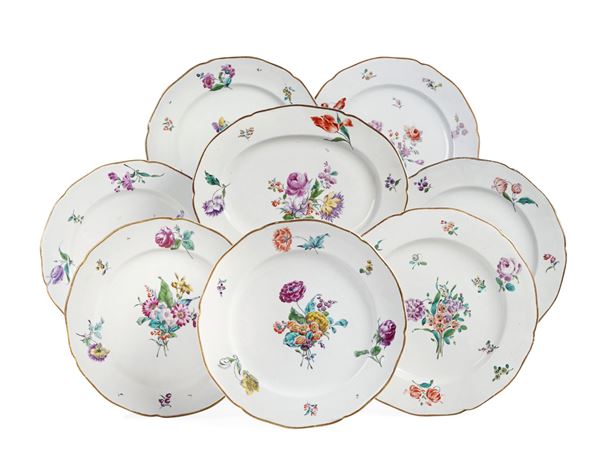
Lot N. 150
Cinquantanove piatti Venezia, Manifattura Cozzi, 1780 circa
Porcellana. Marca: ancora in rosso. Conservazione: ottima; alcuni piatti con insignificanti sbeccature al bordo; qualche usura allo smalto I piatti, dal bordo [..]
Estimate
€ 8.000,00 / 12.000,00
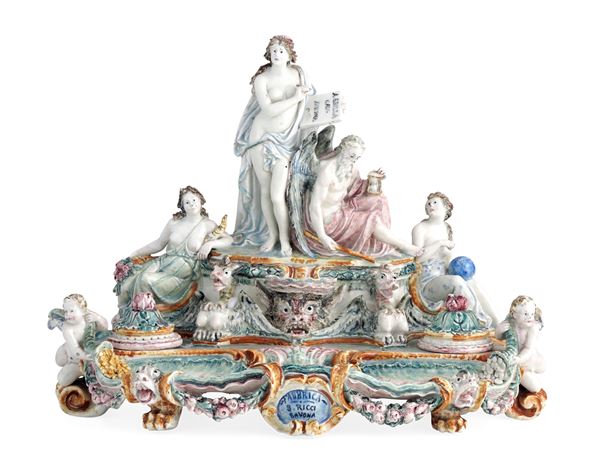
Lot N. 122
Monumentale Calamaio Savona, Manifattura di Sebastiano Ricci, 1885, opera di Antonio Brilla
Maiolica. Marca: “Fabbrica S. Ricci Savona”, data “Savona 1885” poste in scudi; “A. Brilla Cav Savona” sulla tavoletta della ninfa. Dimensioni: altezza cm 34; lunghezza [..]
Estimate
€ 200,00 / 400,00
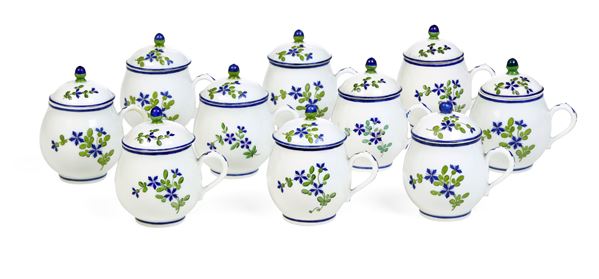
Lot N. 163
Dieci cremiere Torino, Manifattura di Vinovo, periodi Gioanetti (1780-1815), 1800 circa
Porcellana. Marca: “V” con “+” e due puntini in blu. Altezza cm 8,8 circa. Conservazione: ottima; un pezzo con manico restaurato; un coperchio con mancanza di parte [..]
Estimate
€ 1.200,00 / 1.600,00
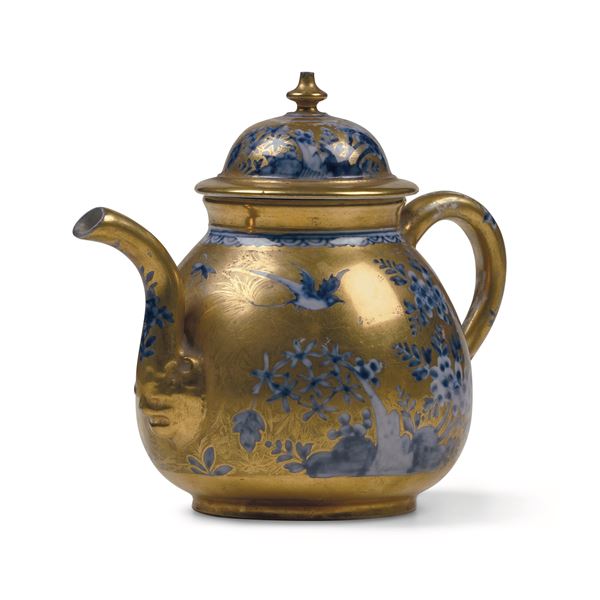
Lot N. 125
Teiera Meissen, verso il 1725 Decorazione in oro, probabilmente Augsburg, 1730 circa
Porcellana. Marca: spade in blu. Altezza cm 14. Conservazione: ottima; insignificanti usure all'oro. La teiera è stata dipinta dapprima in blu presso la manifattura [..]
Estimate
€ 2.000,00 / 2.600,00
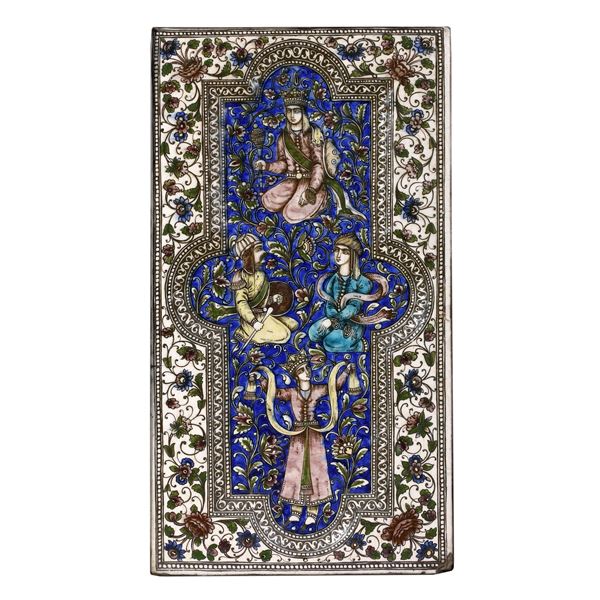
Lot N. 2
Mattonella Persia (Iran), periodo Qatar (1779-1925), XIX secolo (1870-1880 circa?)
Ceramica silicea. Dimensioni: cm 43x23,5. Conservazione: ottima; una sbeccatura allo spigolo inferiore sinistro. Cornice in legno (cm 70x49,5) Mattonella da rivestimento [..]
Estimate
€ 1.500,00 / 2.500,00
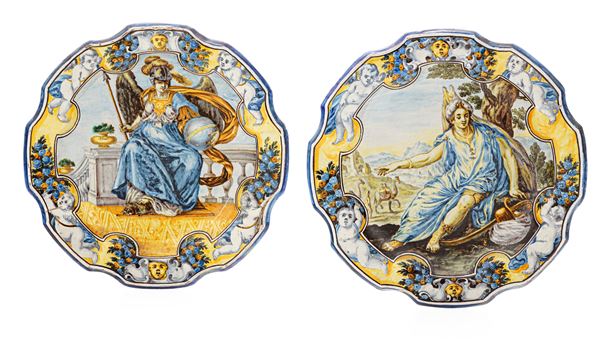
Lot N. 59
Coppia di piatti “a coste” Castelli o Atri, Aurelio Grue, 1750 circa
Maiolica. Diametro cm 25,5. Conservazione: ottima; insignificanti salti di smalto ai bordi e una leggera felatura alla tesa di un piatto Due piatti tondi, modellati [..]
Estimate
€ 4.000,00 / 6.000,00