Evaluation Giorgio Morandi
Giorgio Morandi Valuations - Want to sell a Giorgio Morandi piece? Request a complimentary and confidential valuation!Cambi Casa d'Aste will review your submission and offer a free-of-charge estimate, if your item is suitable for our auctions.
biography
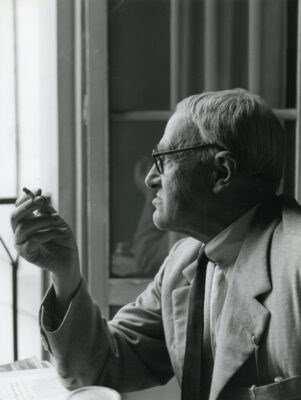
Giorgio Morandi, born in Bologna on July 20, 1890, to Andrea Morandi and Maria Maccaferri, was one of Italy's greatest 20th-century painters and engravers, renowned for his essential **still lifes** and landscapes defined by the poetics of 'Morandism'. The eldest of five children in a petty bourgeois Bolognese family, he showed an early passion for drawing, enrolling in 1907 at the Accademia di Belle Arti in Bologna, where he graduated in 1913 alongside peers like Osvaldo Licini, Severo Pozzati, and Mario Bacchelli. His father's death in 1909 made him head of the family, moving to via Fondazza 36, where he lived with his mother and sisters for most of his life, painting in his room and spending summers in Grizzana, a key inspiration for many landscapes.
Initially influenced by Cézanne, Picasso, and Renaissance masters like Giotto and Piero della Francesca, Morandi explored diverse styles: a brief flirt with Futurism in 1914 and Metaphysics in 1918 with De Chirico and Carrà, leading to a mature, autonomous, intimate, and metaphysical language. From 1930 to 1956, he taught 'etching techniques' at Bologna's Accademia, appointed 'for clear fame' without competition, and exhibited at Venice Biennials from 1928, showing paintings and etchings. Key shows include the 1935 Rome Quadriennale, the 1941 Cortina Collectors' Exhibition prize, and personal exhibitions up to 1963 at Geneva's Galerie Krugier.
During World War II, evacuated to Grizzana from 1943, he created intense landscapes foreshadowing his final works. In 1963, he received Bologna's Archiginnasio d'oro. He died on June 18, 1964, in Bologna, after signing his last canvas in February, leaving a legacy of over 1000 oils, 1300 etchings, and works embodying silence, solitude, and essentiality, influencing generations. Bologna's Museo Morandi preserves his studio, emblem of his solitary, art-dedicated life.
Initially influenced by Cézanne, Picasso, and Renaissance masters like Giotto and Piero della Francesca, Morandi explored diverse styles: a brief flirt with Futurism in 1914 and Metaphysics in 1918 with De Chirico and Carrà, leading to a mature, autonomous, intimate, and metaphysical language. From 1930 to 1956, he taught 'etching techniques' at Bologna's Accademia, appointed 'for clear fame' without competition, and exhibited at Venice Biennials from 1928, showing paintings and etchings. Key shows include the 1935 Rome Quadriennale, the 1941 Cortina Collectors' Exhibition prize, and personal exhibitions up to 1963 at Geneva's Galerie Krugier.
During World War II, evacuated to Grizzana from 1943, he created intense landscapes foreshadowing his final works. In 1963, he received Bologna's Archiginnasio d'oro. He died on June 18, 1964, in Bologna, after signing his last canvas in February, leaving a legacy of over 1000 oils, 1300 etchings, and works embodying silence, solitude, and essentiality, influencing generations. Bologna's Museo Morandi preserves his studio, emblem of his solitary, art-dedicated life.
Past lots of Giorgio Morandi

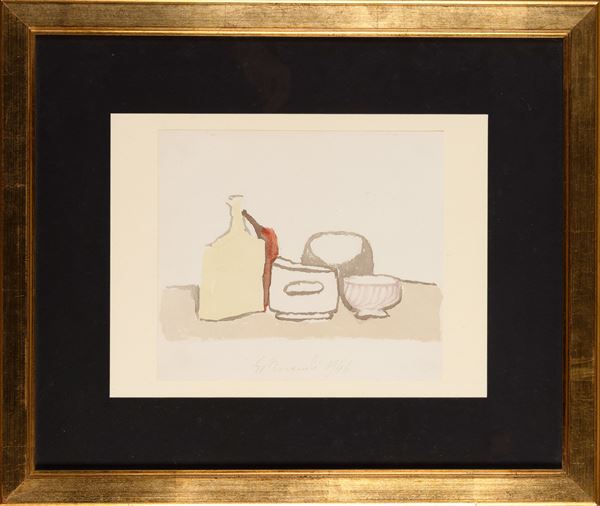
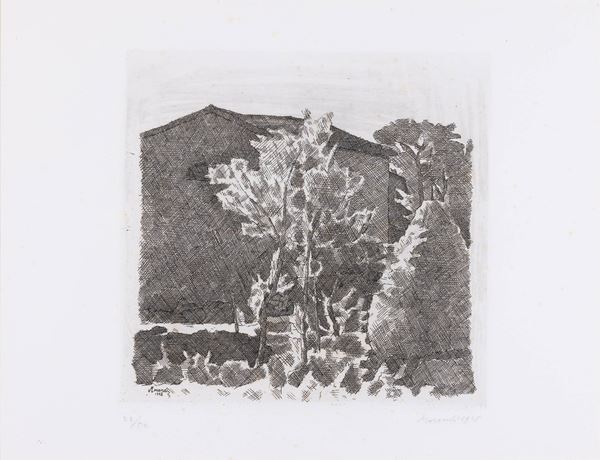
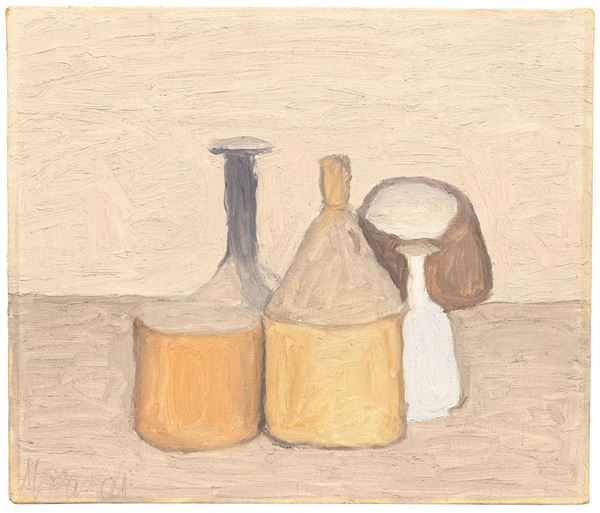
Giorgio Morandi©
(Bologna, 1890 - Bologna, 1964)
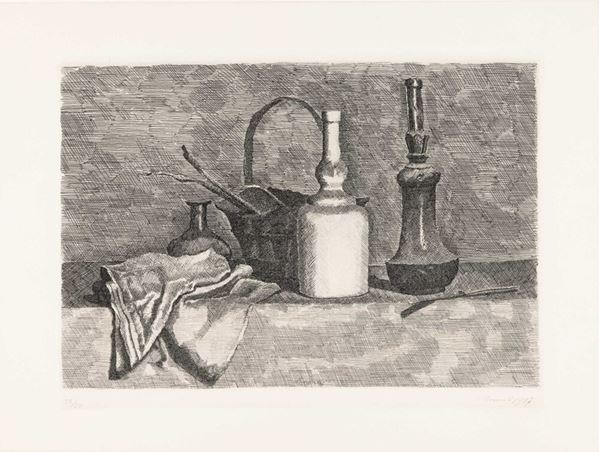
Grande natura morta con la lampada a destra
es. 27/75, Edizioni Graphica Nova, Milano Firmato e datato in basso a destra Numerato in basso a sinistra Acquaforte Largh. [..]
Sold
Giorgio Morandi©
(Bologna, 1890 - Bologna, 1964)
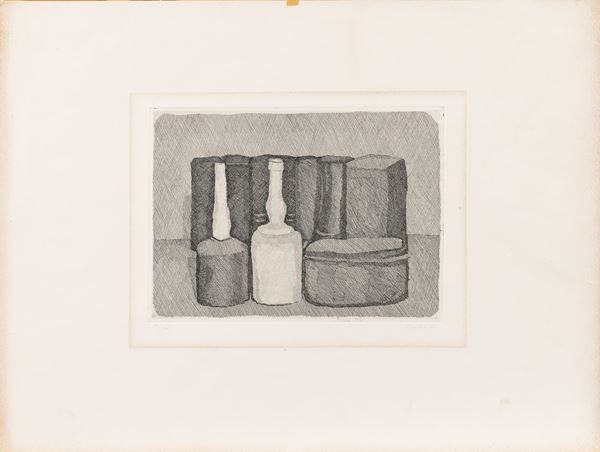
Natura Morta con panneggio a sinistra
plate dimensions: 24,3 x 35,5 cm ex. 26/50 signed and dated lower right, numbered lower left etching W. 50,5 - H. 34,7 Cm [..]
Sold
Giorgio Morandi©
(Bologna, 1890 - Bologna, 1964)
Natura morta in un tondo
es. 46/50, Edizioni Galleria del Milione, Milano Firmato e datato in basso a destra Numerato in basso a sinistra Acquaforte [..]
Sold
Giorgio Morandi©
(Bologna, 1890 - Bologna, 1964)
Natura morta
signed and dated lower center pencil on paper W. 23,5 - H. 16 Cm
Sold
Giorgio Morandi©
(Bologna, 1890 - Bologna, 1964)
Paesaggio del Poggio
dimensioni lastra: 23,4 x 29 cm es. 20/50 firmato e datato in basso a destra, numerato in basso a sinistra acquaforte Largh. [..]
Sold
Giorgio Morandi©
(Bologna, 1890 - Bologna, 1964)
Natura morta con nove oggetti
dimensioni lastra: cm 18 x 25 es. 66/100 firmato in basso a destra, numerato in basso a sinistra acquaforte Largh. 49,3 [..]
Sold
Giorgio Morandi©
(Bologna, 1890 - Bologna, 1964)
Paesaggio di Roffeno
es. 49/60 Firmato e datato in basso a destra numerato in basso a sinistra Acquaforte Largh. 19,9 - Alt. 15,8 Cm
Sold
Giorgio Morandi©
(Bologna, 1890 - Bologna, 1964)
Natura morta con nove oggetti
ex. 18/100 on a print run of 10 copies numbered I/X for the artist and 100 copies numbered 1/100 for the Associazione Amatori [..]
Sold
Giorgio Morandi©
(Bologna, 1890 - Bologna, 1964)
Gelsomini in un vaso a strisce
dimensioni lastra: 31,5 x 24,8 cm firmato in basso a destra, numerazione non visibile su una tiratura di 50 esemplari Etichetta [..]
Sold
Giorgio Morandi©
(Bologna, 1890 - Bologna, 1964)
Paesaggio con il grande pioppo
dimensioni lastra: 32,3 x 23,3 cm es. 10/50 firmato e datato in basso a destra, numerato in basso a sinistra acquaforte [..]
Sold
Giorgio Morandi©
(Bologna, 1890 - Bologna, 1964)
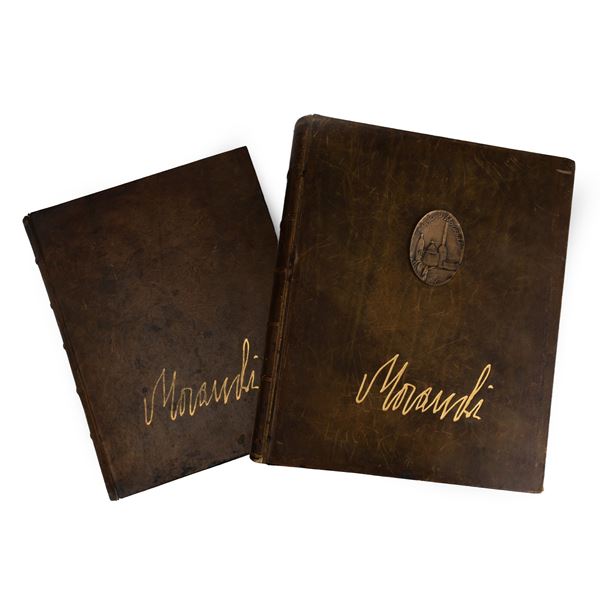
Morandi
es. 1020 su una tiratura complessiva di 1120 copie + 13 copie fuori commercio volume con le cinquanta riproduzioni degli [..]
Giorgio Morandi©
(Bologna, 1890 - Bologna, 1964)
Alberi fra due case a Grizzana
firmato e datato in lastra litografia Largh. 28,5 - Alt. 39 cm
Giorgio Morandi©
(Bologna, 1890 - Bologna, 1964)
50 Acquarelli di Morandi
TREC edizioni riproduzione offset Largh. 48 - Alt. 37 cm
Giorgio Morandi©
(Bologna, 1890 - Bologna, 1964)
Poggio al mattino
ex. 22/50 signed and dated lower right, numbered lower left stamp on the back by Galleria Rotta, Genoa etching W. 51,8 - [..]
Giorgio Morandi©
(Bologna, 1890 - Bologna, 1964)
Still life
Signed lower left Inscription in pen on the stretcher: no. 430 of the Morandi Archive Stamp on the reverse from Galleria [..]
Giorgio Morandi©
(Bologna, 1890 - Bologna, 1964)
Il poggio di sera
dimensioni lastra: cm 14x24,5 es. 27/52 firmato e datato in basso a destra, numerato in basso a sinistra acquaforte Largh. [..]
Giorgio Morandi©
(Bologna, 1890 - Bologna, 1964)
Poggio al mattino
es. 21/50 firmata in basso a destra, firmata e datata su lastra in basso a sinistra acquaforte su carta Largh. 25 - Alt. [..]